
In LED lighting design, we often talk about three core components: light source, driver, and heat sink. In previous articles, we discussed heat sink technologies such as die-cast aluminum and extruded aluminum, as well as the differences between isolated and non-isolated LED drivers. However, the light source is where light quality truly begins.
Modern LED luminaires are no longer only expected to “produce light.” Today’s technical requirements demand high color rendering, flicker-free operation, smart dimming support, slim form factors, and long-term reliability. The choice of light source directly determines brightness uniformity, color accuracy, eye comfort, thermal load, and overall service life.
This article focuses on the main types of LED light sources used in modern luminaires, their working principles, advantages, limitations, and typical applications.
1. Main LED Light Source Categories
LED light sources can be classified in several ways, but the most practical way for product design and blog readers is to group them by package structure and mounting technology:
- Through-hole LED
- SMD LED
- COB LED
- Flip Chip LED
- Flexible LED strip
Each type has a different internal structure, thermal path, light distribution, and cost profile. More importantly, each one matches differently with heat sink design, driver selection, and smart lighting functions.
2. Through-Hole LEDs: The Older Generation
Through-hole LEDs, also called “plug-in LEDs,” represent the early stage of LED technology. They are mounted with two metal pins inserted and soldered through the PCB, usually with a round or rectangular epoxy lens.
Advantages
- Very low cost
- Simple structure
- Mature manufacturing process
- Basic resistance to static electricity
Limitations
- Limited light output
- Narrow beam angle
- Poor heat resistance
- Not ideal for modern high-efficiency lighting
- Generally unsuitable for smart dimming systems
Applications
Through-hole LEDs are still common in indicator lights, toys, small decorative lights, and simple electronic devices. However, they are rarely used in modern main lighting luminaires.
3. SMD LEDs: The Standard Mainstream Light Source
SMD LEDs are the most widely used light source in modern LED lighting. Common models include 2835, 3030, and 5050, which indicate the approximate dimensions of the package in millimeters.
SMD LEDs are mounted directly onto the surface of a PCB, making them suitable for automated production, slim luminaire designs, and uniform panel lighting. Unlike some high-power modules with large domed lenses, most general-purpose SMD packages use a flat or near-flat phosphor encapsulation, which keeps the cost low and manufacturing consistent.
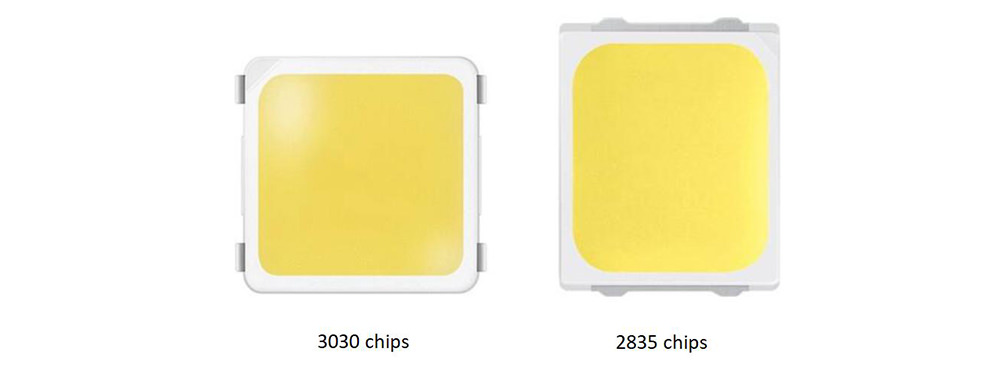
SMD 2835
SMD 2835 is a rectangular 2.8 × 3.5 mm flat-top SMD package. It is widely used in panel lights, downlights, linear lights, and low-to-medium power indoor luminaires. Because of its mature structure and good cost performance, it remains one of the most common light sources in mass-produced LED lighting.
SMD 3030
SMD 3030 is a 3.0 × 3.0 mm square flat-top package. It generally offers better thermal performance and higher power capability than the 2835 type. For this reason, it is often used in commercial panel lights, downlights, spotlights, track lights, and outdoor floodlights.
SMD 5050
SMD 5050 is a 5.0 × 5.0 mm square flat-top package. It has a larger footprint and can accommodate higher current or multi-chip designs. It is very common in LED strips, decorative lighting, sign lighting, and some color-tunable applications.
Advantages of SMD LEDs
- Mature and cost-effective
- Good light uniformity
- Wide beam angle options
- Suitable for slim luminaire designs
- Compatible with isolated and non-isolated drivers
- Available in high CRI and flicker-free versions
- Easy to apply in mass production
Limitations
- Can show slight dot-matrix texture at close range
- Dense PCB layouts require careful thermal design
- Low-quality SMD packages may suffer from color shift and flicker
Applications
SMD LEDs are suitable for home lighting, office lighting, commercial panel lights, downlights, spotlights, street lights, and most general-purpose LED luminaires.
4. COB LEDs: High Color Quality and Uniform Light
COB LEDs are packaged differently from SMD LEDs. Instead of many individual surface-mount LEDs spread across a PCB, COB technology places multiple LED chips directly onto a single substrate, forming one continuous light-emitting surface.
This structure creates a very smooth and uniform light source with almost no visible LED dots. For this reason, COB is often preferred in lighting applications where visual comfort and color accuracy are important.
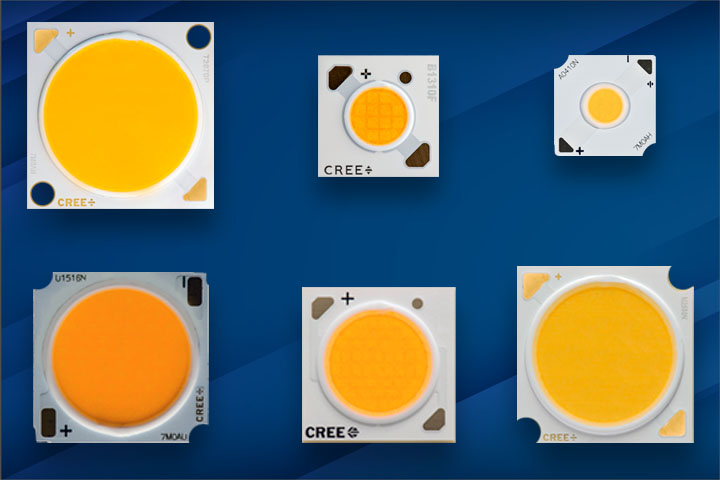
Advantages
- Excellent light uniformity
- Very low glare
- High color rendering performance
- Smooth dimming behavior
- Compact high-power design
- Good thermal performance when paired with a proper heat sink
Limitations
- Higher cost than standard SMD LEDs
- More sensitive to package quality
- If the substrate or encapsulation fails, the entire module may need replacement
- Requires good thermal design to prevent premature aging
Applications
COB LEDs are widely used in high-end spotlights, track lights, museum lighting, jewelry lighting, retail display lighting, photography lights, and architectural accent lighting.
5. Flip Chip LEDs: High Power and High Reliability
Flip Chip LEDs are mainly used in high-power lighting applications. Unlike traditional LEDs, flip chip technology mounts the LED chip upside down, directly connecting both electrodes to the substrate without wire bonds.
This design improves heat transfer and mechanical reliability, making it suitable for demanding environments.
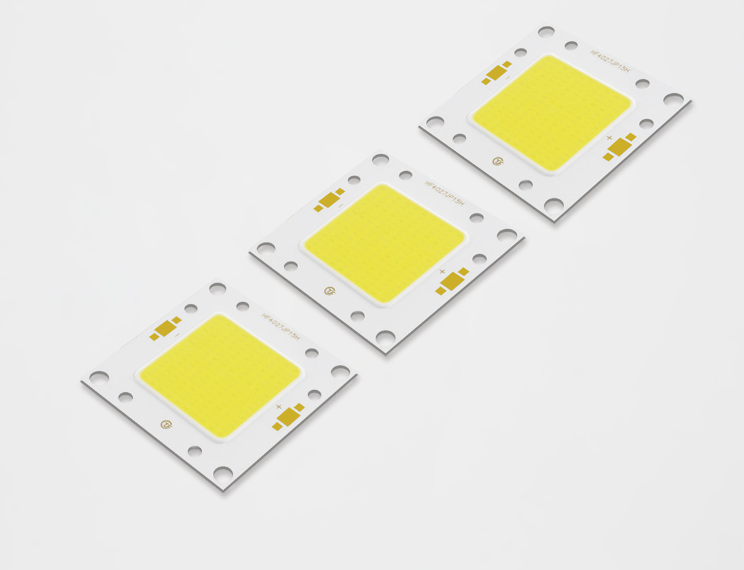
Advantages
- Excellent thermal conductivity
- High power density
- Good reliability under continuous operation
- Resistance to vibration and temperature changes
- Suitable for large-area high-brightness lighting
- Long-term stability in industrial and outdoor applications
Limitations
- Higher packaging cost
- Requires robust heat sink design
- Not necessary for low-power residential lighting
- Thermal interface quality strongly affects lifespan
Applications
Flip Chip LEDs are commonly used in high bay lights, low bay lights, floodlights, stadium lights, tower lights, explosion-proof lights, and heavy-duty outdoor lighting.
6. Flexible LED Strips: Ambient and Decorative Lighting
Flexible LED strips are thin, bendable circuits with small SMD LEDs mounted along a flexible substrate. They are widely used for decorative and supplementary lighting.
Low-Voltage LED Strips
Low-voltage strips usually operate at 12V or 24V DC. They are safer, easier to dim, and popular in modern interior lighting.
Applications:
- Cove lighting
- Cabinet lighting
- Shelf lighting
- Hotel ambiance lighting
- TV background lighting
- Step lighting
High-Voltage LED Strips
High-voltage strips operate at 220V AC and do not require a separate low-voltage driver. They are easy to install but generally less suitable for high-quality long-term indoor lighting.
Applications:
- Temporary decorative lighting
- Outdoor signage
- Festival lighting
- Low-cost linear decoration
7. How to Match Light Source, Driver, and Heat Sink
A good LED luminaire is not only about choosing a good light source. The light source, driver, and heat sink must work together.
SMD LED + Slim Heat Sink
SMD LEDs work well with extruded aluminum heat sinks or compact die-cast heat sinks. For home and office lighting, this combination provides a good balance between cost, efficiency, and reliability.
COB LED + High-Quality Heat Sink
COB LEDs need stable thermal management because the heat is concentrated in one area. They should be paired with thick extruded aluminum, high-quality die-cast aluminum, or even ceramic-based thermal solutions.
Flip Chip LED + Heavy-Duty Heat Sink
Flip Chip LEDs are often used in high-power luminaires. They require large die-cast heat sinks, fin structures, and sometimes thermal grease or thermal pads to maintain long-term performance.
Smart Lighting Considerations
For dimmable, color-temperature adjustable, or sensor-based luminaires, it is also important to choose light sources and drivers that support smooth dimming, constant current control, and low flicker.
8. Final Thoughts
LED light sources are not all the same. For modern lighting design, the choice between SMD, COB, Flip Chip, and flexible strip directly affects the final quality of the product.
- SMD LEDs are the most practical choice for general lighting.
- COB LEDs are ideal for high-color-quality and comfortable lighting.
- Flip Chip LEDs are the best choice for high-power industrial and outdoor lighting.
- Flexible LED strips are mainly used for ambiance and decorative lighting.
The key is to select the light source based on the actual application, and then match it with a suitable driver and heat sink. Only in this way can an LED luminaire achieve high efficiency, long life, low flicker, and reliable performance.